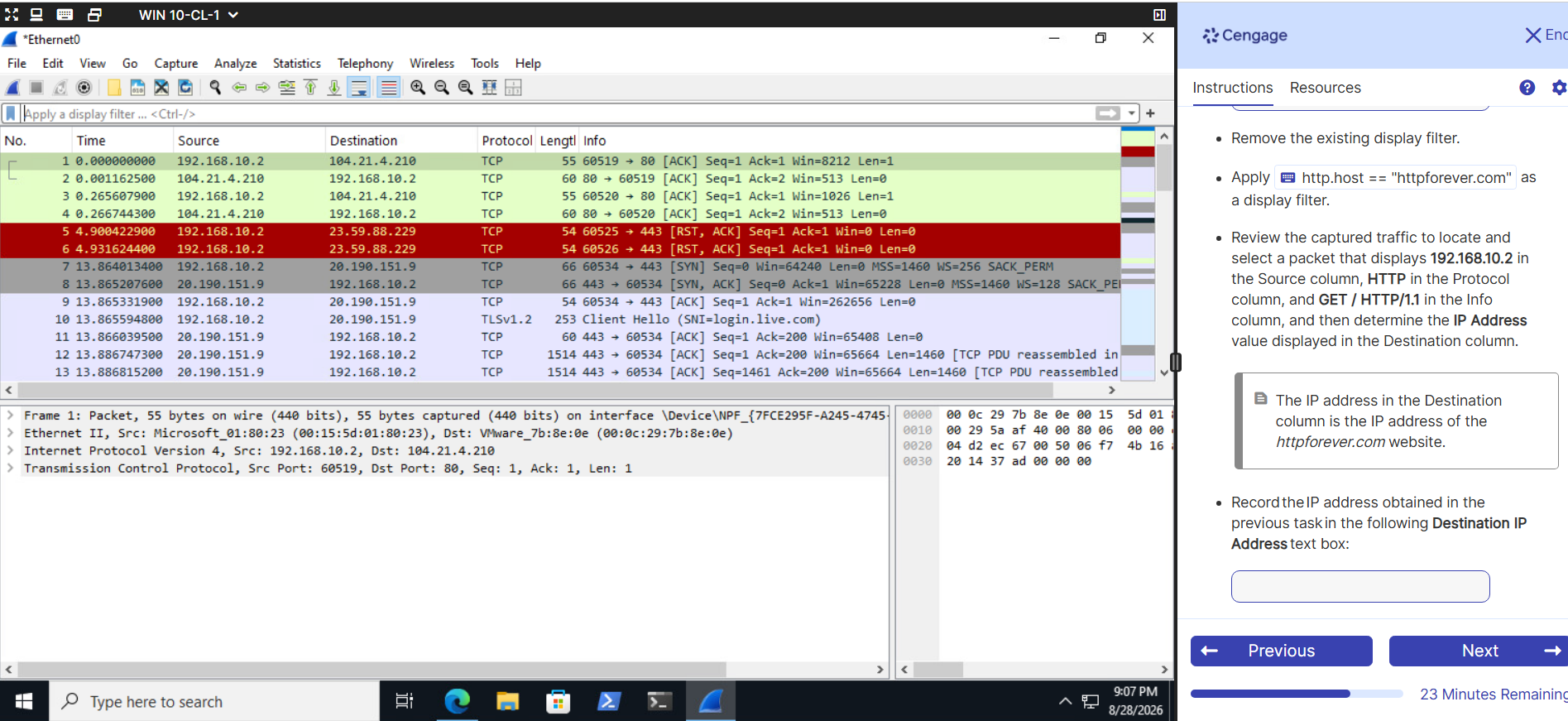
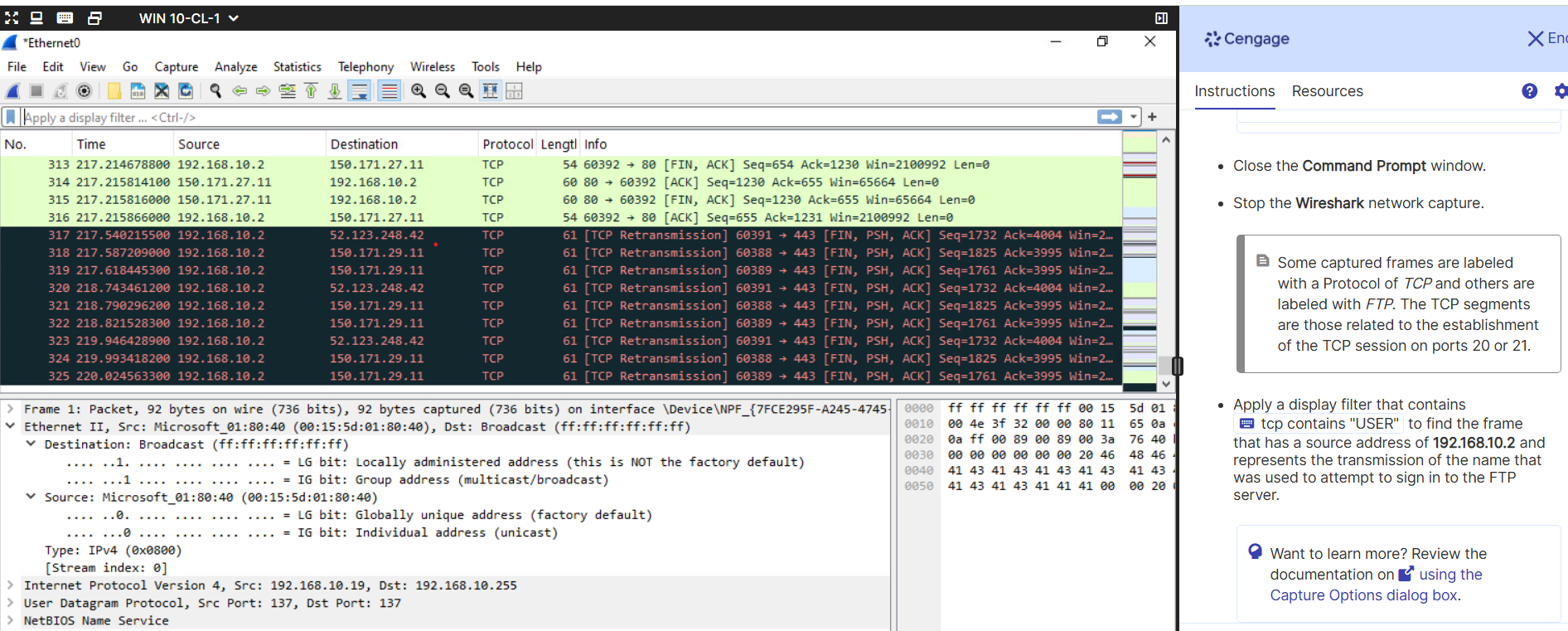
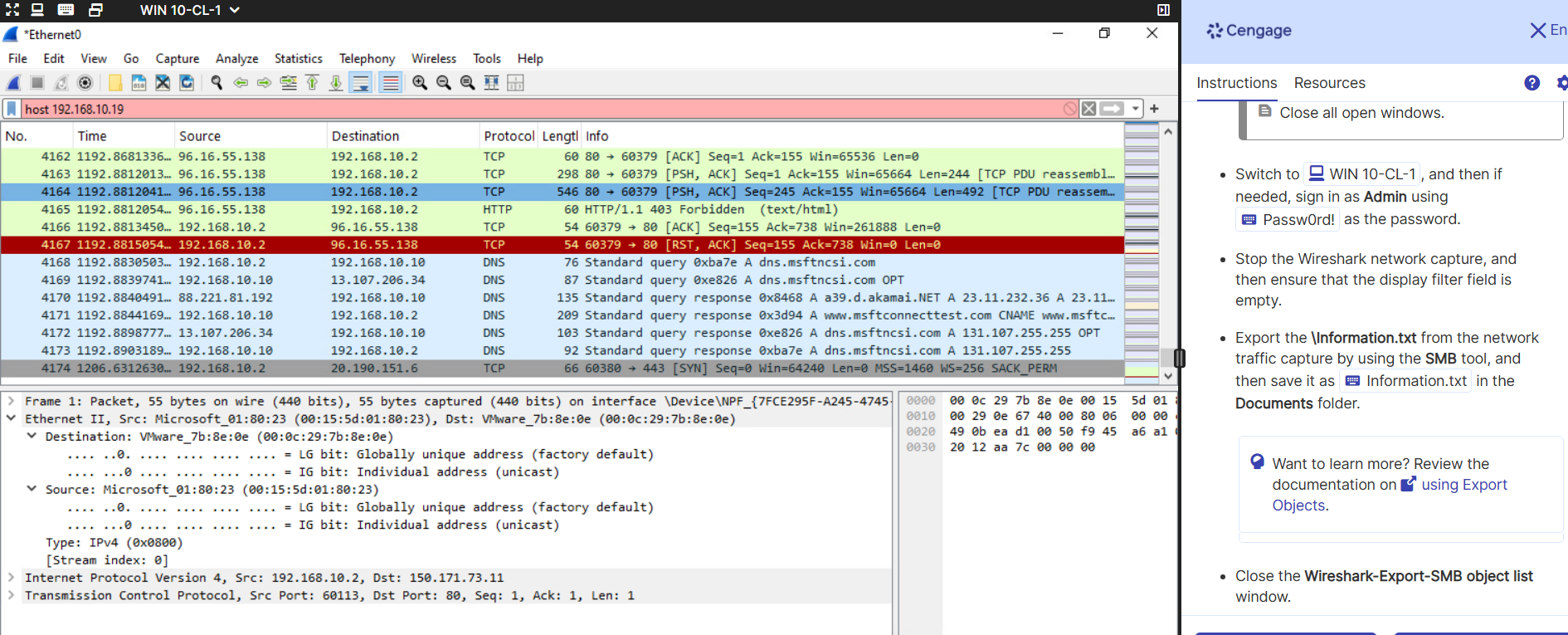
Network traffic consists of a constant record of the way devices, services, and applications communicate. By means of packet capture, part of that activity is turned into evidence that can then be examined and interpreted. During my CYSE 600 lab exercises I realised that effective analysis requires more than simply opening a packet-analysis tool; the analyst has to know where the capture is occurring, select the right interface, generate or observe appropriate traffic, and make sure that packets are actually being captured before reaching any conclusions. As a result, packet analysis came to seem less like merely watching lines of data and more like reconstructing a sequence of events.
A packet capture contains useful information at many layers: it shows Ethernet details which identify the local hardware addresses, Internet Protocol information which gives the source and destination IP addresses, and transport-layer information that displays the ports, flags, and connection behaviour. The application protocols provide context regarding the service in use. Taken together, these fields can provide answers to practical questions such as which host started the communication, whether a connection was completed, whether a service was accessed repeatedly, and whether the traffic used the expected protocol and port. It is precisely these questions that enable an analyst to progress from a collection of raw packets to one backed by evidence (Wireshark Foundation, n.d.).
It is essential to use filtering since a brief capture may include more traffic than an individual can assess efficiently. Capture filters determine what is collected, whereas display filters restrict the traffic that is shown after collection. The difference is important in that a capture filter that is too restrictive might permanently exclude valuable evidence, while a display filter can be modified without affecting the original capture. When carrying out the analysis, filters can be applied to a protocol, an address, or a port in order to identify the relevant conversations. Nevertheless, a filter should be used to address a specific investigative question and not take the place of a thorough understanding of the surrounding traffic (Wireshark Foundation, n.d.).
The project also placed a strong emphasis on troubleshooting. If a capture shows up as empty there are a number of possible reasons: the wrong interface might have been chosen, the test system might not be generating traffic, the permissions might be too low, a filter might be excluding the packets, or the capture might have started at the wrong time. The proper course of action is to check each of these conditions in turn, make one change at a time, and then verify the result. This approach is the same problem-solving method that I apply in manufacturing and in technical instruction, since altering more than one variable at a time makes it more difficult to determine the actual cause.
From a security point of view, packet analysis is useful for monitoring, carrying out incident response and for verification. Multiple attempts to make a connection could be a sign of scanning or might indicate that an application is not working properly. The use of unexpected protocols can show that unauthorized services are present. Traffic for applications that is not encrypted may result in sensitive data being exposed. Communication with external systems that are unfamiliar may provide a reason for further investigation. At the same time, however, the fact that a packet has been captured does not by itself prove that there is malicious activity; analysts should take into account the context, compare their observations with what is expected, keep records of the timestamps and must not draw any conclusions that the evidence does not support (NIST, 2007, 2008).
Packet capture also involves ethical and operational responsibilities. It may involve usernames, system identifiers, internal addresses, and the content of applications. It should only be carried out on systems and networks for which the analyst has obtained authorization. The files thus obtained should be protected, kept only for as long as is necessary, and shared only with the relevant personnel. Such boundaries are important since a tool which can be used for defense and for troubleshooting may also compromise privacy if used without permission (NIST, 2008).
In summary, the project has improved my ability to link network theory with actual behaviour. I now regard packet capture as a structured procedure: I define the question, carry out the capture from the right location, keep the evidence, filter it carefully, interpret the protocols, record my findings, and communicate the limitations. The most valuable outcome wasn't just gaining knowledge of how to obtain packets; it was learning how to use technical evidence to arrive at a reasonable and defensible conclusion. This ability will prove useful in my future work in cybersecurity, in investigations, and in any other role where accuracy and accountability are important.